What is the significance of the wave-particle duality? Wave-particle duality is truly fascinating. It’s where physics becomes poetry.
When we don’t observe an electron, it behaves like a wave; when we do, it behaves like a particle. Whatever we zero in on becomes discrete — turns into bits and pieces. Whatever we don’t observe behaves like a wave — Music. Why? Physics doesn’t answer that question. Poetry does.
Everything we zero in on becomes fragmented. The fallen mind perceives the world in bits and pieces. It wants to control by analyzing and manipulating. It believes that the whole equals the sum of its parts. It wants to understand the bits and pieces to control the whole. It fails. The Whole is always larger than the sum of its parts.
When we are focused on the parts, reality appears as discrete. It doesn’t yet show us what it is. When we stop zeroing in on its parts, it suddenly changes its behavior and becomes… Music. The Wave. It waves at us so we wake up from the illusion of control and attune to the Music of the Whole.
Is the world a particle or a wave? A particle when we observe it with a view to seeing its parts. And a wave when we stop looking for parts and look for participation. We no longer look at it but through it. The world becomes transparent. We see through it. It is no longer an idol. It is an Icon that reveals to us the mystery of the Whole.
The world is Music from the invisible realm incarnated in its many parts. When we stop looking for parts we begin participating in the Whole. We become artists. When an artist creates art, they may be looking at individual parts of the picture, but they must hear the Music of the Whole at all times — otherwise, no part will come out right.
All artists know that. You must hear the Music first, and then every stroke of your paintbrush will fall in its place. The Whole reveals to us the meaning of each part. We no longer zero in on the part itself to understand the Whole. We focus on the Whole to understand its parts.
When we start with participation, we understand every part. When we start with observing parts, we don’t understand even the parts. When we look AT the world, it is an idol. When we look THROUGH the world, it is an icon. We become perceptive of the Music from beyond the visible realm which gives meaning to each individual part. We realize the world is a huge Parable that opens up to us when we grok the Whole.
Werner Heisenberg said:
“Quantum theory provides us with a striking illustration of the fact that we can fully understand a connection though we can only speak of it in images and parables.”
And Albert Einstein:
“The most beautiful thing we can experience is the mysterious. It is the source of all true art and science.”
Our gaze is magical. If we look to see parts, we will find them. Our gaze will create them. If we look to catch the Wave, we will. When we catch it and ride it, we will participate in the Great Music, and everything around us will become a Parable.
“Don’t you understand this parable? How then will you understand any parable?” Jesus in Mark 4:13
How do you conquer the ego? The French philosopher Jacques Lacan says,
“What determines me, at the most profound level, in the visible, is the gaze that is outside.”
According to Lacan, it is highly curious that human behavior and self-perception drastically change the moment we become aware of being looked at. An outside gaze, when caught, changes us profoundly. No one remains the same when they know they are being seen.
Why?
Because we are revealed as human beings only when we are seen. The Gaze is the ultimate revelatory act. Dante says of Beatrice’s eyes in Vita Nuova:
“Whenever and wherever she appeared, by virtue of my hope in her marvelous greeting [gaze], no one could be my enemy; on the contrary, I became possessed by a flame of charity that made me forgive whoever had hurt me, and were someone to ask me any question at that moment, my response would have been, simply, “Love,” my expression clothed in humility.”
Dante had many enemies and yet, the moment he caught her gaze, no one in the world could remain his enemy. Suddenly, in the twinkling of an eye, all inner struggle subsided, and humility arose — without struggle, as a response to the gaze. What Dante saw in that gaze was different than what Petrarch encountered in Laura.
For Petrarch — and many others — their earthly love was a distraction from God. Petrarch’s inner struggle was precisely that Laura competed with God for his heart. For Dante, Beatrice was not a distraction from God but theophany. There was no competition. Through her eyes, God revealed His own gaze.
What happened in that gaze? Suddenly, unexpectedly, Dante felt exalted and humbled at the same time. True humility always arises as an inner response to being seen. False humility is an attempt to bring oneself down without the awareness of being seen.
Such attempts are never successful. In fact, they only inflate the ego further.
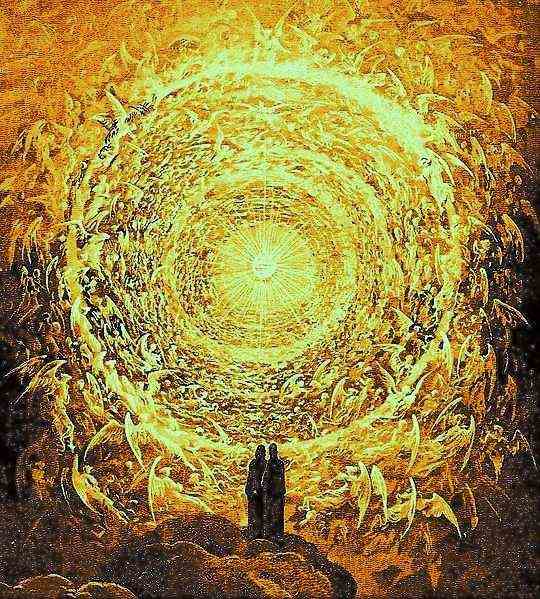
True humility is a profound paradox: we feel most humble when we feel most exalted — in the Divine Gaze. When we catch that Gaze, we know we are singled out, made precious, chosen. That Gaze lifts us to the seventh heaven.
At that moment, the ego dies a quiet and happy death. We no longer need to establish or exalt ourselves. We already feel exalted to the highest heights. Unless we are exalted by the Other, we will inevitably attempt to exalt ourselves. The moment we become aware of how we are being looked at, the ego falls silent.
The Gaze humbles us by revealing who we truly are. This is the most humbling experience of all: to discover who we are in the eyes of the Lover. The Gaze humbles by extolling.
C.S. Lewis said:
True humility is not thinking less of yourself: it’s thinking of yourself less.
But it is impossible to think of yourself less without first being exalted by the Gaze. The Gaze lifts us to such heights that all our attempts at self-exaltation suddenly appear absurd. We give them up instinctively. It simply makes no sense to think much of oneself once we become aware of how we are being seen.
The paradox of humility is that it’s the flip side of being exalted — by the loving gaze. People think much of themselves only because they are unaware of being seen. The ego exalts itself precisely when it does not know how greatly it has already been exalted.
It puffs itself up and seeks to grow ever larger until one day — somewhere in the middle of the Ponte Vecchio — it lifts its eyes and is suddenly smitten by how it is being looked at. In that instant, it begins to laugh at its own efforts at self-exaltation.
All human attempts at self-exaltation are ridiculous, because if only we knew how greatly we have already been exalted, we would exclaim with Dante: “I am possessed by a flame of charity,” and we would answer every question with a single word:
What is the difference between facts and history? When I read my history textbook back in school, I often thought: Gosh, there are so many facts about this or that person or event, but so little story. Isn’t history supposed to be a story?
For some reason, I felt that facts ought to cohere into a story. They didn’t.
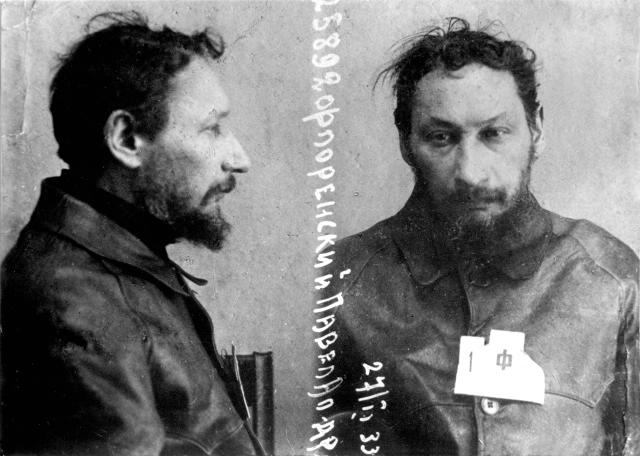
The same thing happened just yesterday after I read Pavel Florensky’s biography on Wikipedia. The article lists many “historical” facts about his life, yet somehow misses the point of who he was entirely. Speaking of his last years before his execution in 1937, it states:
“On November 15, 1934, he began working at the Solovetsky camp iodine production plant, where he focused on the extraction of iodine and agar-agar from seaweed and patented four scientific innovations.”
The passage almost sounds as if he was simply assigned this work by the authorities. He wasn’t. It was his conscious choice.
Researching and extracting iodine from seaweed allowed Florensky to remain spiritually alive and sane in a death camp. He knew perfectly well that Solovki would most likely become his grave, and so he chose to pursue something that filled him with life. And he succeeded. Everyone who met him there was astonished by how much life this man radiated in the face of death.
Wikipedia missed the most essential thing — the Wonder he perceived, embodied, and sought in all things.
“What resulted were fairytale-like caves made of the purest crystal ice — radiant ice, fibrous ice, white ice, and at the bottom, reddish-brown, yet completely transparent… I don’t have the ability to describe how beautiful it is, nor can I draw it. One day, you’ll see a series of sketches of the columns and other details, but even those sketches don’t come close to conveying the beauty of these caves. I doubt that any artist could truly capture it — it’s too difficult a task. It’s better to read fairy tales.”
This passage tells us more about Florensky than all the facts combined. Why?
Because history does not consist of facts. The word history comes from the Ancient Greek ἵστωρ (hístōr), meaning a wise man or a witness. History is the story of a witness.
To know history, you must have seen something — physically or spiritually (or both). History is not so much the retelling of past events as it is the testimony about something seen. The “history” in my school textbook was not history in this proper sense. It did not consist of stories told by witnesses. It was a compilation of facts: who did what, when, how, and why.
Facts without vision do not make history. Witness does.
A hístōr is someone who sees. I must see Pavel Florensky inwardly while reading his words. Only then will I know true history. Facts are part of history, but they do not constitute it. The most important moments of history rarely make it to the official record. Wonder cannot be archived.
Florensky did not remain spiritually alive in Solovki by accident, nor did he “labor” there in the usual sense of the word. He bore witness — to beauty in permafrost, to meaning in degradation, to life where death expected to reign alone.
Why doesn’t AI understand context? Martin Heidegger famously argued:
“The essence of technology is nothing technological.” — The Question Concerning Technology
What, then, is its essence? Its essence is “enframing”— a way of giving us a particular lens through which to view the world. Modern technology is Gestell: a mode of disclosing reality, not a tool. It reveals reality as “standing-reserve.”
But is this true?
The New York Times recently published an article titled “Companies Are Pouring Billions into A.I. It Has Yet To Pay Off.” And Forbes echoed it with an article: “Companies Are Pouring Billions into A.I. Here’s Why They’re Not Seeing Returns.” Why is this happening?
The New York Times emphasizes the human side: employees resist tools they do not trust. Forbes zeroes in on technical issues: AI still fails to understand the context of work. Surprisingly, the solution proposed in both cases is itself technical in nature —training AI to “understand” context.
But can AI understand context? Context is what surrounds the text — the background that allows us to understand the true meaning of words, events, or ideas. How do you train AI to understand context? Companies tend to propose only one solution: feed it more data.
Yet, reducing context to data is precisely what Heidegger calls enframing. Context is not data; it appears as data when we look at it through a technical lens. But what is context proper? The word context comes from the Latin con (“with, together”) and texere (“to weave”). Literally, context means “a weaving together.”
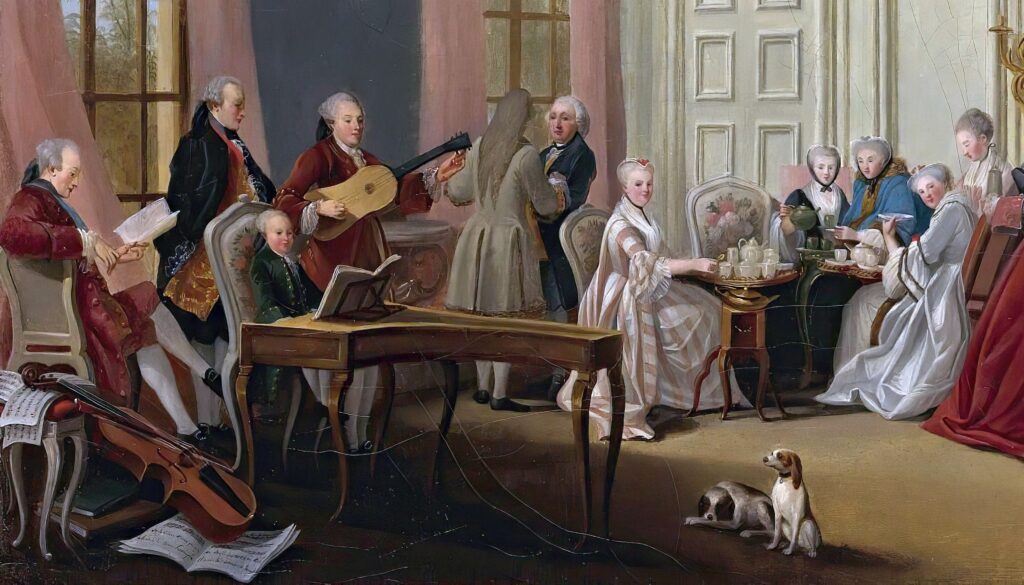
To understand context, we must be weavers. It’s more art than science. To truly understand my friend’s words, I must artfully weave the individual threads of what I know about them into a single, meaningful picture. A weaver doesn’t simply assemble the picture from bits and pieces — they weave a tapestry from disparate threads based on the vision of the Whole.
A weaver cannot produce a coherent Whole unless they have first seen the Whole. True art is recreating on earth what we saw in heaven. We can only weave what we have seen — the Heavenly Pattern. AI cannot see the Heavenly Pattern. And because it cannot see, it cannot truly weave. That is why it cannot genuinely understand context.
All humans are Platonists by nature — we instinctively grasp the Idea behind every thing. AI cannot see Platonic Ideas, and therefore it cannot weave. Reality is not data; it is textile — fabric. It is not assembled from bits and pieces but woven from Logos-colored threads, revealing something that comes from beyond this world.
The employees in those companies are human, and they instinctively sense what AI cannot. That is why they distrust it. Will this ever change? To be able to weave — to grasp context — you must be able to see the invisible.
Reality is not data. It is fabric. It is a tapestry — a visible image of what cannot be seen by the physical eyes. To dwell in the world contextually means to artfully weave on earth what has been revealed in Heaven.
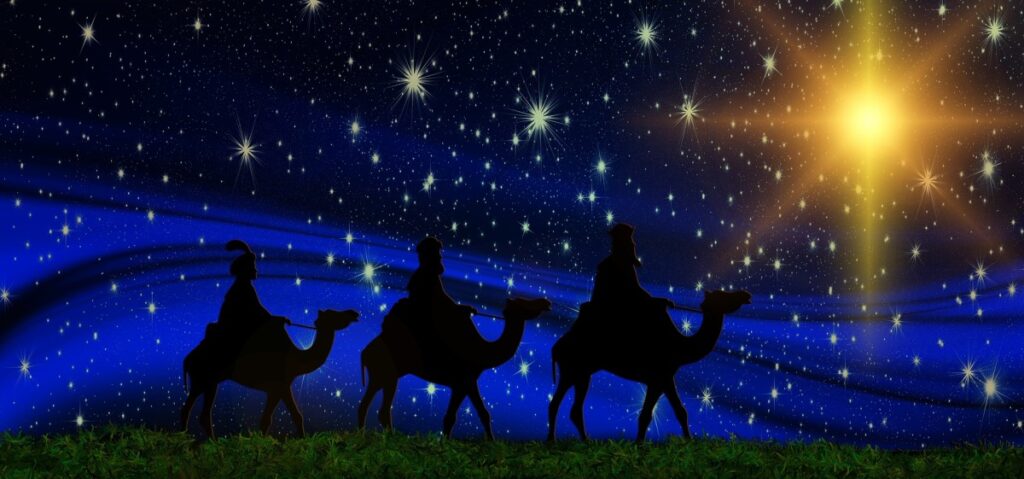
Why do we crave adventure? Babushka: A Christmas Tale is a children’s tale by Dawn Casey. It’s a simple yet touching story about an old grandma who was busy tidying her home when a bright star shone in the sky.
Soon, three wise men knocked on her door. After she had fed them a hearty meal, they offered her a gift — an invitation to join them on their journey to find the newborn babe, the Prince of Peace.
Somewhat flustered, Babushka must have felt exactly like Bilbo Baggins on that memorable day when Gandalf nudged him out the door to join the dwarves on their adventure. And, like Bilbo, Babushka excused herself by saying she had dishes to do and floors to clean.
The next morning, she woke up to find them gone. To her utter surprise, an aching longing smote her heart. She realized she had made a terrible mistake.
Rushing out the door, she searched desperately, asking everyone she met if they had seen the three wise men. Yet, they were nowhere to be found. And so, as the story goes, Babushka is still wandering to this day — searching, asking, hoping… and giving gifts to anyone she meets.
The moral of the story?
When we choose comfort over adventure, we are always left with the residue of longing. The more we settle in our ways, the more painful the realization that we are missing out on something big and real. We see some people following the star and shrug our shoulders: “Fools. They are chasing after the wind.”
And yet, after they leave, we are overcome by an inexplicable yearning. It dawns on us that we have made a terrible mistake by NOT following the star — the call to adventure. We have been the fools; we have been chasing after the wind. We leap up and begin looking for those strange vagabonds.
We are looking for our “tribe” — those who follow the yonder star. We roam the world searching, looking into people’s eyes as if silently asking, “Are you going there too?” The greatest reward is when we find someone with the same glint in their eyes. They are looking for the same thing!
“Don’t mention it [your adventure] to anyone else unless you find that they’ve had adventures of the same sort themselves. What’s that? How will you know? Oh, you’ll know all right. Odd things they say — even their looks — will let the secret out. Keep your eyes open.”
And Dostoyevsky mused:
“Beauty is a terrible thing. God and the devil are fighting there and the battlefield is the heart of man.”
Beauty is a terrible thing because it is a call. It ignites a battle in our hearts. We long for it, and yet we resist it at the same time. But sooner or later, we hear a knock on the door. We open it and see strange but happy people with a glimmer in their eyes — the shimmer of the yonder star.
They eat and drink with us and invite us on an adventure. We think, “This is madness. I can’t leave like this — without my handkerchiefs, without first cleaning my floors.” But the next morning, the travelers are gone, and a thought strikes us like a lightning bolt:
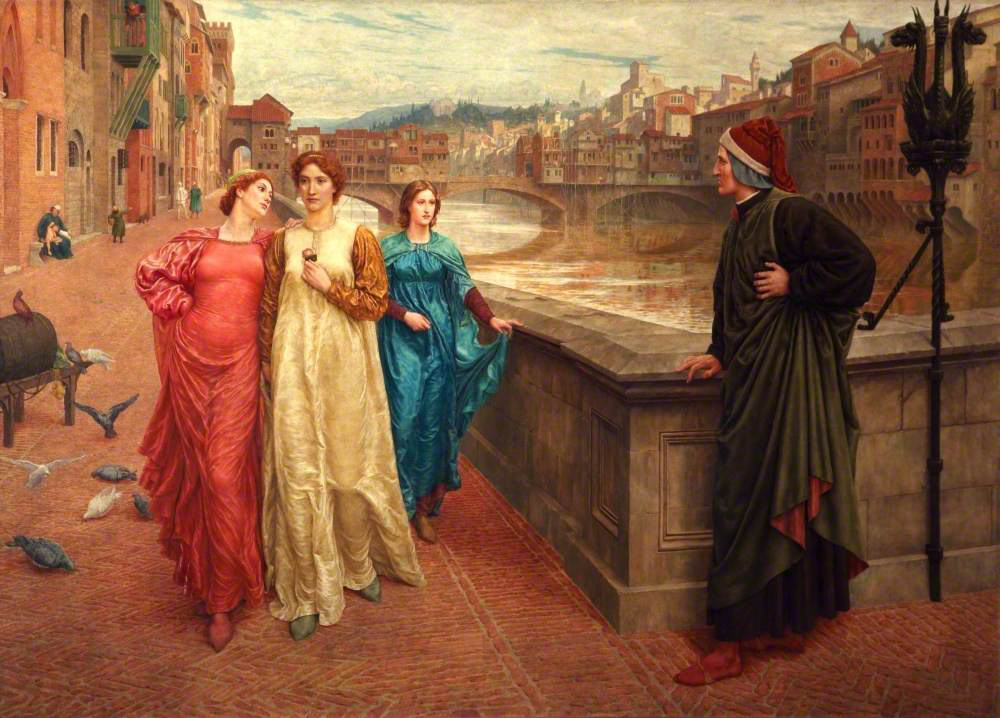
Holiday, Henry; Dante and Beatrice; Walker Art Gallery; http://www.artuk.org/artworks/dante-and-beatrice-97987
Why wasn’t the Ponte Vecchio bombed during World War II? World War II is full of its legends. In the summer of 1944, as Allied forces closed in on Florence, retreating German troops were ordered to destroy every bridge over the Arno to slow their advance.
Every bridge was blown up — except the Ponte Vecchio. The German officer assigned to demolish it refused. “This is the bridge where Dante met Beatrice,” he said. “I cannot possibly destroy it.”
He then radioed the Allies and informed them that the bridge would remain intact — on one condition: they must promise not to use it. The agreement was honored, the Ponte Vecchio was spared, but the officer himself was executed for disobedience.
What compelled this man to sacrifice his life for a bridge? The bridge must have spoken to him about something worth more than life itself — the beauty of the Divine hidden behind ordinary things. Dante’s love for Beatrice was unique in that he never separated his love for an earthly woman from his love for God.
In fact, loving Beatrice was not a distraction from God but the very path to God. For Petrarch — and many other poets — their earthly love was a distraction from God. Petrarch’s inner struggle was precisely that Laura competed with God for his heart.
He loved her intensely, but he also felt guilty that this human passion distracted him from pursuing God. Not so with Dante. He said of Beatrice:
O lady, you who strengthen my hope and who, for my salvation, have suffered to leave your footprints even in Hell…
Icon and idol are often the same thing — the difference lies in how we look. If we look at a thing, it becomes an idol. If we look through it, it becomes an icon. Dante looked through Beatrice and communed with Divine Light.
Perhaps that is what the German officer saw on the Ponte Vecchio that day. Perhaps he caught a glimpse of that light through the bridge and realized that it was worth more than life itself.
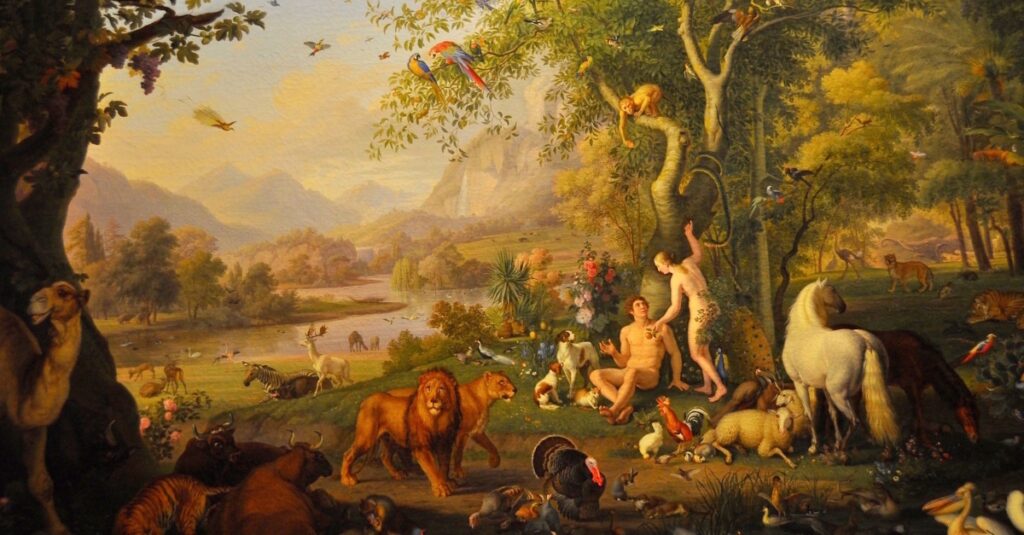
What creates human connection? I like to look at backyards. They reveal what people love to surround themselves with. Whether we realize it or not, most of us unconsciously — and sometimes consciously — try to re-create the Garden of Eden behind our homes.
We intentionally gather things that make us feel safe, calm, and at home. When we see those trees, bushes, flowerbeds, firepits, patios, swings, zip-lines, saints, and everything else we’ve placed there, we feel as if we’re standing inside our own Garden of Eden. Having such a space gives us a sense of safety.
The enclosure of the backyard becomes a protective wall, symbolically shielding us from the chaos of the outside world. And every “thing” within that enclosure speaks to us.
The word “Paradise” itself comes from the Old Persian “pairidaeza,” which means “enclosed garden” or “walled enclosure.” In the Bible, it first appears in the Septuagint. The word consists of two parts: “pairi-” (around) and “-daeza” (wall or enclosure).
Paradise is an enclosure — a place surrounded by a wall. It’s an enclosed circle. Within this circle, everything is secure. Outside of it, danger lurks. Little children understand the meaning of Paradise when they cling to their mother’s knees. They instinctively remain within their safe zone — an invisible enclosure — until they feel secure enough to venture out.
On this side of the Garden of Eden, we must have some form of enclosure — a place full of mighty Guardians that keep watch day and night at the borders of our realm. We must feel protected from the outside world — to build immunity within.
Without Paradise, no one feels safe enough to venture into the big, wide world. Without the experience of being surrounded by Guardians — our own symbolic gargoyles — the world will swallow us. Paradise is necessary for building immunity. And, paradoxically, immunity is what makes community possible.
True community is impossible without immunity. Unless I feel safe — unless I catch a glimpse of my own protective gargoyles out of the corner of my eye — I cannot truly connect with anyone. My ability to dwell in community is directly related to my experience of immunity within my Paradise.
If I lack the experience of Paradise, I will lack the immunity needed to commune. And without immunity, all connection is fragile or distorted. Only those who feel safe enough — loved, enclosed, embraced — can form true community. Those who do not feel safe, loved, enclosed, and embraced cannot connect in a healthy way.
When the individual is swallowed by the collective, neither individuality nor community survives. To have true community, there must first be immunity. Each of us must have the experience of dwelling in a “walled enclosure” where we feel totally safe, loved, and embraced — only then can we truly connect.
How is a war won? Two years into the war, the chief psychiatrist of the Rehabilitation Center “Unbroken” in Lviv, Ukraine, said to the volunteers who wished to work 12-hour shifts:
“If you work yourselves to death for twelve hours a day, you’ll end up in the psychiatric ward as my patients.”
These people were driven by the most natural instinct we all feel in times of crisis — to prioritize duty over joy. When you see so much need and suffering around you, you think: “I will put off joy and first do what must be done.”
And yet, according to the Ukrainian philosopher Alexander Filonenko, this is a grave mistake. Those who make duty their first priority never truly fulfill it. Duty is never accomplished from a mere sense of duty. Those who try to “white-knuckle” adversity inevitably fail.
Interestingly, after the war began, bookstores in Ukraine quickly ran out of books by the Stoics. The common misconception about the Stoics is that they teach how to endure adversity through willpower. It is not true.
Stoicism is more about joy than willpower.
“The happiness of your life depends upon the quality of your thoughts.” — Marcus Aurelius, Meditations 5.16
Stoicism is not so much about self-denial as about changing your thoughts. Stoics are not the stone-faced people. They’re those who actively work on changing their thinking.
“Men are disturbed not by things, but by the views they take of things.” — Epictesus
The only way to endure a crisis is to do the most counter-intuitive thing — prioritize joy over duty. The only way to survive hell is to keep enough visions of heaven before your eyes. Those who focus on duty never fulfill their duty. Those who focus on joy cannot help but fulfill it.
What do war-injured people need the most? Medical care? Supplies? Prosthetics? “UNBROKEN” answers: beauty. Beauty is the only force that revitalizes the soul and helps the body heal. It is the only power that can lift a person from the ashes. That is why UNBROKEN invites orchestras, ensembles, and individual musicians to perform for patients right inside the rehabilitation center.
So far, they have hosted the Academic Symphony Orchestra of the Lviv National Philharmonic, held various concerts connected to veteran and wounded-soldier rehabilitation, and, in one 2023 performance, classical musicians played beside wounded soldiers. And more continue to come.
To survive, one must thrive. Survival can never be achieved by aiming at survival. When our world crumbles, we must do the most counter-intuitive thing — turn our gaze to Beauty. Beauty is the only thing that truly “changes our thoughts.”
“The soul becomes dyed with the colour of its thoughts.” — Marcus Aurelius
What is the color of my soul today? It takes on the color of my thoughts — always. No war is won by endurance alone. It is won when I immerse my soul in the colors of joy and allow meaning to transform my thoughts.
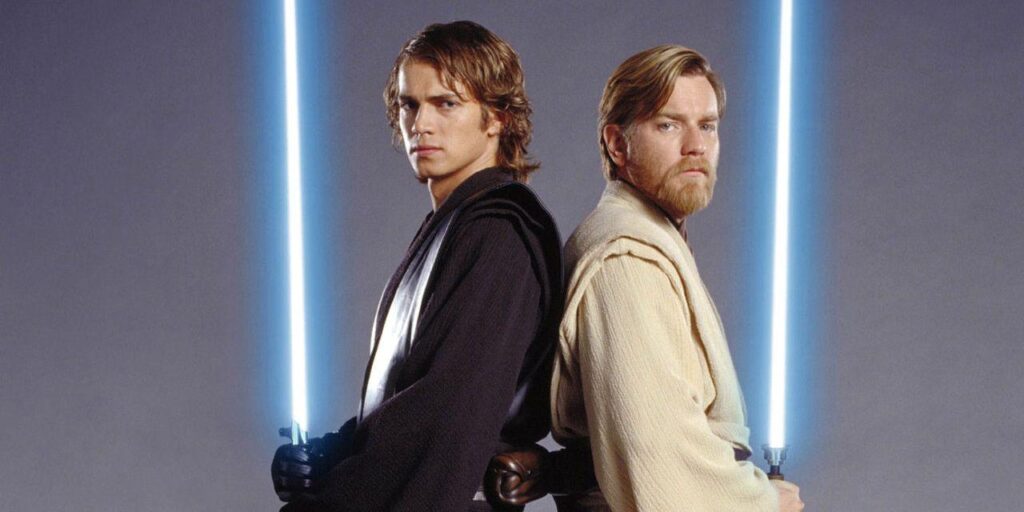
What was Obi-Wan’s mistake with Anakin? Speaking of Anakin, Obi-Wan Kenobi once said to Qui-Gon: “The boy is dangerous. They all sense it. Why can’t you?”
Qui-Gon replied: “His fate is uncertain; he is not dangerous.”
Surprisingly, they were both right. Obi-Wan foresaw Darth Vader emerging from Anakin; Qui-Gon foresaw Anakin emerging from Darth Vader.
And yet, Obi-Wan’s early view of Anakin as “dangerous” shaped the entire trajectory of their future relationship. Obi-Wan failed to recognize Anakin’s deepest human need — the need for a father. And he failed to become that father when Anakin was his Padawan. Why? Is it because Obi-Wan himself grew up without a father?
Obi-Wan could hardy remember his parents. In Star Wars canon, Obi-Wan Kenobi’s father is not named. At twelve, Obi-Wan became Qui-Gon’s Padawan, and for a while, their relationship was tense — Obi-Wan was rigid and rule-abiding; Qui-Gon spontaneous and free-spirited.
Obi-Wan kept the rules; Qui-Gon followed the ways of “the living Force.” Eventually, they came to appreciate each other but sharply disagreed about Anakin.
Obi-Wan: “He’s dangerous.”
Qui-Gon: “He is the Chosen One.”
Even after Qui-Gon’s death, Obi-Wan saw Anakin as “dangerous.” He agreed to train the boy out of duty and respect for his fallen master, but he never saw him through Qui-Gon’s eyes — as the Chosen One. Obi-Wan didn’t choose him. That’s why Anakin never felt chosen.
Obi-Wan failed to see what every boy craves the most — for someone to see him as the Chosen One.
True fathers always see their child as the Chosen One. In their gaze, the child becomes his true self. Anakin didn’t find it in Obi-Wan’s eyes, and he turned to Palpatine for answers. When a child does not feel chosen, he will seek identity in the darkest places. Children do not want dutiful love. They reject it — and the one who dutifully gives it.
With Luke, Obi-Wan was different. He waited for years on Tatooine until Luke came of age — not out of obligation, but out of hope. By the time they met, Obi-Wan had clearly chosen him. And Luke felt that from the very first moment they met — chosen.
Obi-Wan never criticized Luke’s fear, impatience, or ignorance as he once scolded Anakin. Instead, he bestowed upon him a mythic identity by telling him the words Anakin had never heard: that he was the son of a Jedi Knight.
Obi-Wan had vowed to train Anakin — and failed. Twenty years later, he finds Anakin’s son to fulfill his promise. This time, he does it not as a reluctant mentor but as the father Luke desperately needs. And Luke FEELS chosen.
This is why, when Palpatine tempts Luke with the same dreadful choice he once offered Anakin — Turn to the dark side, or watch your loved ones die —Luke does not cave.
Only those who FEEL CHOSEN can overcome the Evil One. Unless I have a father-imparted identity, I will cave. The role of the father is to give you a name — something you cannot lose. Luke knew who he was — the Chosen One — and he redeemed his father in himself.
The moment Luke put down his lightsaber, Darth Vader died and Anakin resurrected. At that moment, Qui-Gon’s prophecy about Anakin came true:
How do abusive fathers affect their sons? Svetlana Alliluyeva, Stalin’s daughter, spoke in a BBC interview in the 1980s about her father’s early childhood. Joseph Stalin was born into the home of a poor Georgian peasant, Besarion Jughashvili, who was a violent alcoholic.
He beat his wife, Keke, regularly, and he beat young Joseph “mercilessly.” According to Svetlana, the boy once tried to defend his mother by throwing a knife at his father — but missed.
While watching the interview, I felt an uncanny sense of déjà vu. Ivan the Terrible’s childhood was surprisingly similar. After the death of his both parents, the boy fell into the hands of the feuding boyars who neglected him and often left him without food and clothing.
Then another story came to mind — that of the Polish journalist Krystyna Kurczab-Redlich, who conducted independent research into Vladimir Putin’s past. After speaking directly with his mother, who was still alive in the 1990s, she published a book containing details that never entered the official narrative.
To cut the long story short, Vladimir grew up essentially without a father. His mother later married a Georgian man who adopted him. This stepfather, too, was a violent drunkard. He beat both the boy and his mother regularly. Young Vladimir had to learn judo and other “survival” techniques simply to protect himself and her.
Eventually, because of the beatings, his mother sent him to her maternal grandparents in Saint Petersburg.
What happens to a boy’s psyche when his father — the one who is supposed to protect him — instead forces him into daily survival mode? Unconsciously, the child develops the deep, instinctual desire to “kill the father” and take his place.
This is what Freud meant by the Oedipus complex. Freud used the Greek myth of Oedipus, who unknowingly killed his father and married his mother, as a model for psychological development in boys. According to him, every boy unconsciously wants to kill his father and marry his mother.
Is this true? Partly. What Freud never emphasizes is that this “desire to eliminate the father” becomes acute precisely in boys who seek a bright father in their earthly father — but find none.
When a father is absent, violent, drunk, or indifferent, a boy experiences a collapse of the inner world. He seeks light but finds only darkness. Deep resentment settles in his heart. Without realizing it, he begins to dream of replacing the father — in any way possible.
We all instinctively know what a “bright father” is supposed to be. That’s why the Romans named their chief god Jupiter. The Latin “Iūpiter” means Father Jove. The first part of the word — Iū — is derived from the Proto-Indo-European “dyew” which means (to be bright, day sky), and “piter” is related to the Latin “pater” (father).
Jupiter, the largest planet in the Solar system (and the biggest bright spot in the night sky also known as the Great Red Spot), was associated by the ancients with the Father. In ancient consciousness, a father is the one who shines. A father is the light of your day. In Roman lore, Jupiter, Jove, is the epitome of joviality — he is full of joy and the energy of being.
When a boy never encounters that kind of brightness in his earthly father, he grows resentful — and profoundly unsure of himself. He tries to compensate through force, aggression, and the pursuit of what he imagines masculinity must look like. The result is not strength but a brittle, armored soul.
Telemachus grew up without a father. Odysseus had left for the Trojan War when Telemachus was still a baby and had been gone for twenty years. As a result, Telemachus became an uncertain and inexperienced young man, watching helplessly as countless suitors courted his mother, Penelope, in his father’s absence. He longed to save her — desperately, instinctively — but didn’t know how.
Curiously, Athena — a goddess of wisdom and war — does not advise Telemachus to become a man of war to “protect his mother” or to compensate for the loss of his father. That would have been a false masculinity. In her wisdom, she tells him to go and look for his father. Ancient stories are infinitely wise.